What a Canarian romería is and how to enjoy it
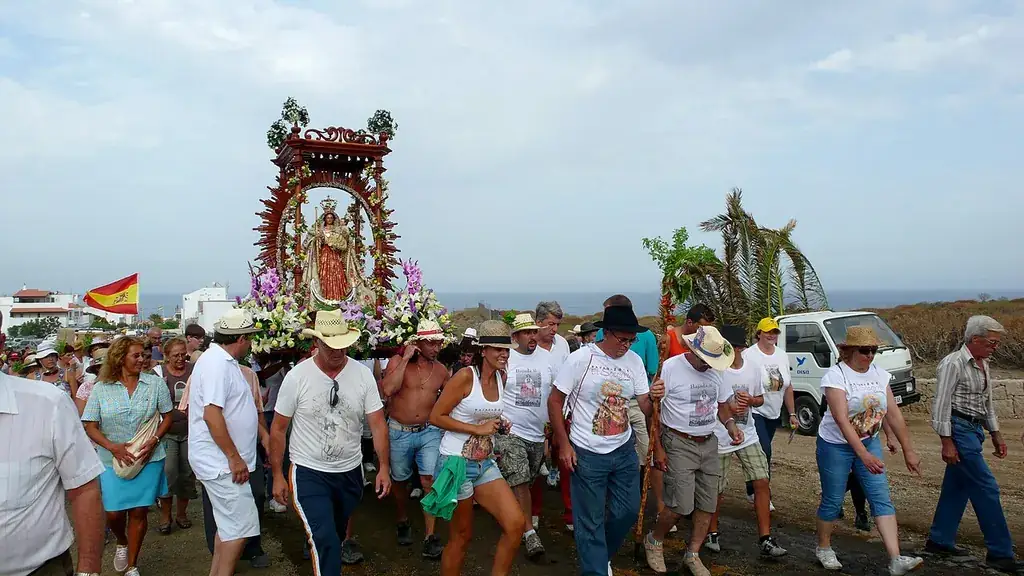
If one fiesta defines the villages of the Canary Islands, it is the romería. It is a festive procession in honour of a saint or the Virgin in which the whole village takes to the streets in traditional dress, following decorated carts, livestock and groups playing and singing. There are romerías on every island and in almost every municipality, especially between spring and the end of summer.
In short: a romería is a mix of procession, parade and popular fiesta. People dress as magos (in traditional Canarian clothing), follow the carretas (carts) and the saint, make an offering of local produce and share food and wine along the way. It usually ends with dancing. It is free and anyone can go.
A romería, step by step
Each village does it its own way, but almost all romerías follow the same pattern:
- The start. The procession gathers at the saint’s church or hermitage and sets off through the streets, often after Mass.
- The parade. Behind the image or its banner come the carretas, carts decorated with flowers, branches, fruit and farm tools, pulled by teams of cows or oxen in the most traditional romerías. Pilgrims and groups playing and singing walk among them.
- The offering. On reaching the saint, locals present produce from the land and the sea: fruit, potatoes, gofio, cheese, wine, fish… It used to be a way of giving thanks for the harvest; today what is collected often goes to the parish or to social causes.
- The fiesta. The romería ends with music and dancing in the square, often until night.
The carts: eating and drinking along the way
The carts are not just for looking at. In many romerías, from the top of the carts the pilgrims hand out local wine, pieces of meat, potatoes, bread or sweets to passers-by. It is one of the happiest moments and part of the spirit of the fiesta: sharing what you have. The normal thing is to accept with a smile and say thank you.
Many carts are prepared by groups of friends, neighbourhood associations or families who have done it for years, and some romerías give prizes to the best decorated.
Mago and maga dress
In the Canary Islands, country people are called magos and magas, and so the traditional clothing worn at romerías is known as traje de mago. There is no single Canarian costume: each island, and sometimes each area, has its own, with differences in skirts, waistcoats, hats, blankets and colours. The most careful versions reproduce the clothing of the 18th and 19th centuries.
You don’t need to dress as a mago to go to a romería, but you will see that most people do. If you want to join in, in many villages there are shops and associations that hire or sell traditional pieces, and a white shirt with a sash or a scarf already gets you into the spirit.
The music: parrandas, timple and folklore
No romería is complete without music. Folk groups and parrandas (more informal groups of friends who play and sing) accompany the carts with guitars, timples, lutes and bandurrias. They sing isas, folías, malagueñas and seguidillas, and people often break into dance in the middle of the street. The timple, a small five-string guitar, is the most characteristic instrument of the Canary Islands.
Some well-known romerías
There are hundreds, but these are some of the biggest and most traditional:
- The Romería de San Benito Abad, in La Laguna (Tenerife), in July, which brings together traditions from every island.
- The Romería de San Isidro, in La Orotava (Tenerife), which closes the Corpus fiestas after the famous flower carpets.
- The Romería de San Roque, in Garachico (Tenerife), in August.
- The Romería de Los Labradores, in Santa Lucía de Tirajana (Gran Canaria), in December, considered the last of the year on the island.
- The Romería de San Sebastián, in La Gomera’s capital, in January, considered the first of the year in the Canary Islands.
Tips for your first romería
- Arrive early. The big romerías draw thousands of people and parking nearby is almost impossible. If there are extra buses, use them.
- Comfortable shoes, water and a cap. There is a lot of walking, often in the sun and up steep streets.
- Respect the animals and the carts. Don’t cross in front of the oxen or climb onto the carts unless invited.
- In moderation. The wine flows generously: if you’re driving, don’t drink.
- Bring some cash for the ventorrillos (food stalls) that are usually set up at the end.
Upcoming romerías in the Canary Islands
- 🐂 Romería de San Sebastián - AdejeTenerife · 20 Jan 2027
- 🌾 Romería de San Marcos - Icod de Los VinosTenerife · 24 Apr 2027
- 🌾 Romería de San Marcos - TeguesteTenerife · 25 Apr 2027
- 🌾 Romería de Valle San Lorenzo - AronaTenerife · 14 May 2027
- 🪗 Romería de Guía de IsoraTenerife · 14 May 2027
- 🪗 Romería de San Isidro Labrador - GáldarGran Canaria · 14 May 2027
- 🪗 Romería de San Isidro - El Puerto de la CruzTenerife · 15 May 2027
- 🌾 Romería de San Isidro - ArtenaraGran Canaria · 16 May 2027
- 🪗 Romería de San Pedro Apóstol - Los RealejosTenerife · 31 May 2027
- 🐂 Romería de San Antonio el Chico - MogánGran Canaria · 5 Jun 2027
- 🪗 Romería de San Isidro - La OrotavaTenerife · 6 Jun 2027
- 🐂 Romería de San Antonio de Padua - MoyaGran Canaria · 13 Jun 2027
More guides
- La Orotava’s Corpus Christi carpets: history and how to see them
- The Bajada de la Rama in Agaete: what it is and how to enjoy it
- The Bajadas de la Virgen in the Canary Islands: what they are and when the next one is
- Native sports of the Canary Islands: what they are and where to see them
- Canary Islands Day: why it is on 30 May and how to enjoy it
- The Fiestas del Pino in Teror: Gran Canaria’s great fiesta
- Canarian fiesta glossary: the words you will hear
- History of the Santa Cruz de Tenerife Carnival
- Saint John’s Night in the Canary Islands: bonfires, swims and traditions
- The pilgrimage to Candelaria: Tenerife’s longest night
- What people eat at fiestas in the Canary Islands
- Christmas nativity scenes 2026 in the Canary Islands: where to see them, dates and times
- Canary Islands Carnival 2027: dates and themes on each island
- Music festivals in the Canary Islands 2027: calendar with dates, island by island
- Christmas lights switch-on 2026 in the Canary Islands: dates by town
- Christmas 2026 in the Canary Islands: markets, nativity scenes and things to do
- Christmas with kids in the Canary Islands 2026: the best plans, island by island
- New Year’s Eve 2026 in the Canary Islands: where to celebrate
- December long weekend 2026 in the Canary Islands: what to do from 4 to 8 December
- Christmas 2026 in Fuerteventura: what to do from December to Three Kings
- Christmas 2026 in Gran Canaria: what to do from November to Three Kings
- Christmas 2026 in Lanzarote: what to do from November to Three Kings
- Christmas 2026 in Tenerife: what to do from November to Three Kings
- Three Kings parades 2027 in the Canary Islands
- Christmas markets in the Canary Islands 2026: dates, opening hours and places by island
- San Andrés 2026 in the Canary Islands: boards, cans and new wine
- El Hierro fiestas: calendar and traditions
- Fuerteventura fiestas: 2026-2027 calendar
- Fiestas in La Gomera by town: 2026–2027 calendar
- Fiestas in La Palma by town: 2026–2027 calendar
- Fiestas in Lanzarote by town: 2026–2027 calendar
- Fiestas in Tenerife by town: 2026–2027 calendar
- Canary Islands markets: days, times and the best on each island
- Fiestas in Gran Canaria by town: 2026–2027 calendar