The pilgrimage to Candelaria: Tenerife’s longest night
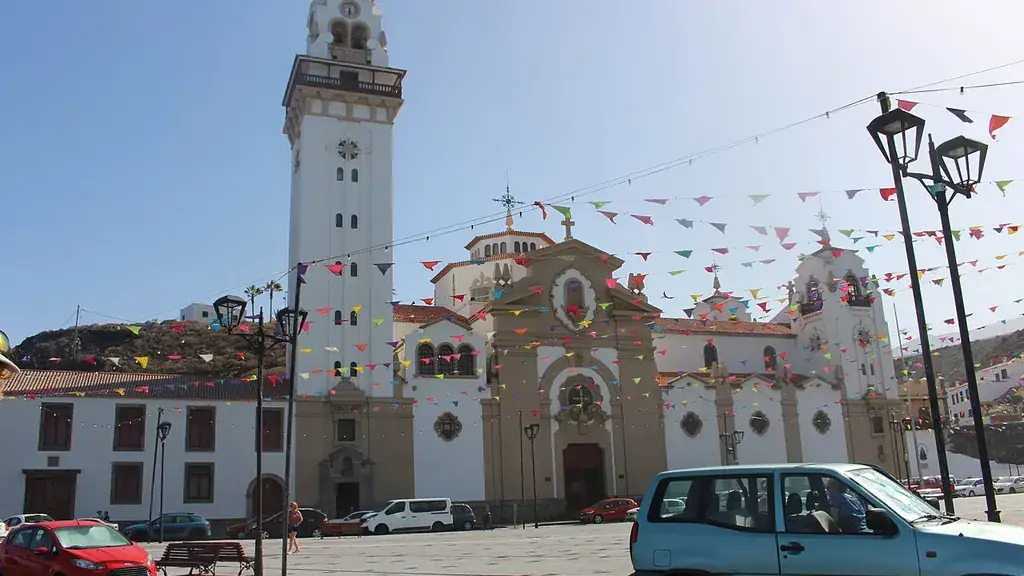
Every year, on the night of 14 August, thousands of people set out on foot from every corner of Tenerife towards Candelaria, on the island’s east coast. They are going to see the Virgen de Candelaria, patron saint of the Canary Islands, whose main feast is on 15 August. Some walk for a few hours; others, all night. Many do it to fulfil a promise.
In short: the pilgrimage is on the night of 14 to 15 August. On the eve, in the Plaza de la Patrona, the Guanche ceremony re-enacts the finding of the Virgin, and on the 15th, Assumption Day, there is a solemn Mass and a procession. Part of the coast road (TF-28) is closed to traffic those days. More on the Virgen de Candelaria fiestas page.
The Virgen de Candelaria, patron of the Canary Islands
According to tradition, the image of the Virgin was found by Guanche shepherds on the coast of Güímar, before the Castilian conquest of Tenerife, and the natives worshipped her in a nearby cave. That is why devotion to Candelaria is tied to the history of the islands and to Guanche memory, and why the large statues of the menceyes, the ancient Guanche kings of Tenerife, stand in the Plaza de la Patrona, facing the sea.
The original image was lost in the 19th century, swept away by a storm, and the one venerated today in the Basilica of Candelaria is later. Even so, devotion has never stopped growing, and Candelaria is the great Marian sanctuary of the Canary Islands.
From February to August
The liturgical feast of Candlemas (Candelaria) is 2 February, and for centuries the great pilgrimage took place on that date. According to the town’s chronicler, after events in the early 18th century it was moved to August, when it is celebrated today. Recently the Town Council has proposed also reviving the February pilgrimage, without touching the August one, which it considers unchangeable.
The night of 14 August
Throughout the afternoon and night, groups of friends, families and lone pilgrims set off on foot from Santa Cruz, La Laguna, the south of the island or even the north, along traditional paths and the hard shoulders of roads. Many carry torches, reflective vests and a backpack; some carry candles or personal promises.
In the town, the Plaza de la Patrona fills from the afternoon. On the eve, the Guanche ceremony is performed, in which a local group re-enacts the finding of the Virgin by the natives. All night long, pilgrims arrive and go into the basilica to see the Virgin, and the atmosphere is a mix of devotion, tiredness and celebration.
15 August, the main day
On the 15th, Assumption Day, there is a concelebrated solemn Mass followed by the procession of the Virgin around the square, with thousands of people. It is the busiest day of the year in Candelaria.
Tips if you are walking
- Be visible. A reflective vest and a torch are essential if you walk at night on the hard shoulder.
- Broken-in shoes and spare socks. Blisters are the great enemy of the night.
- Water and some food. There are stalls and volunteers along the way, but don’t count on them for everything.
- Walk with others and tell someone your route.
- Plan the way back. With the TF-28 closed and thousands of people, getting back by car is difficult; check the special buses.
- If you’re only going to watch, get to the square early and avoid the middle of the 15th if you don’t like crowds.
Fiestas in Candelaria
- ⛪ Fiestas de Santa Ana - CandelariaTenerife · 25 – 28 Jul 2027
- 🕯️ Fiestas de la Virgen de CandelariaTenerife · 14 – 15 Aug 2027
More guides
- La Orotava’s Corpus Christi carpets: history and how to see them
- The Bajada de la Rama in Agaete: what it is and how to enjoy it
- The Bajadas de la Virgen in the Canary Islands: what they are and when the next one is
- Native sports of the Canary Islands: what they are and where to see them
- Canary Islands Day: why it is on 30 May and how to enjoy it
- The Fiestas del Pino in Teror: Gran Canaria’s great fiesta
- Canarian fiesta glossary: the words you will hear
- History of the Santa Cruz de Tenerife Carnival
- Saint John’s Night in the Canary Islands: bonfires, swims and traditions
- What a Canarian romería is and how to enjoy it
- What people eat at fiestas in the Canary Islands
- Christmas nativity scenes 2026 in the Canary Islands: where to see them, dates and times
- Canary Islands Carnival 2027: dates and themes on each island
- Music festivals in the Canary Islands 2027: calendar with dates, island by island
- Christmas lights switch-on 2026 in the Canary Islands: dates by town
- Christmas 2026 in the Canary Islands: markets, nativity scenes and things to do
- Christmas with kids in the Canary Islands 2026: the best plans, island by island
- New Year’s Eve 2026 in the Canary Islands: where to celebrate
- December long weekend 2026 in the Canary Islands: what to do from 4 to 8 December
- Christmas 2026 in Fuerteventura: what to do from December to Three Kings
- Christmas 2026 in Gran Canaria: what to do from November to Three Kings
- Christmas 2026 in Lanzarote: what to do from November to Three Kings
- Christmas 2026 in Tenerife: what to do from November to Three Kings
- Three Kings parades 2027 in the Canary Islands
- Christmas markets in the Canary Islands 2026: dates, opening hours and places by island
- San Andrés 2026 in the Canary Islands: boards, cans and new wine
- El Hierro fiestas: calendar and traditions
- Fuerteventura fiestas: 2026-2027 calendar
- Fiestas in La Gomera by town: 2026–2027 calendar
- Fiestas in La Palma by town: 2026–2027 calendar
- Fiestas in Lanzarote by town: 2026–2027 calendar
- Fiestas in Tenerife by town: 2026–2027 calendar
- Canary Islands markets: days, times and the best on each island
- Fiestas in Gran Canaria by town: 2026–2027 calendar