Canarian fiesta glossary: the words you will hear
Canarian fiestas have their own vocabulary, mostly in Spanish and often unique to the islands. If you are visiting, or just want to understand a fiesta programme better, here are the words you will hear most, in alphabetical order and explained simply.
The five essentials: verbena (open-air dance), romería (festive procession with carts), murga (carnival group singing satirical songs), ventorrillo (fiesta food and drink stall) and guagua (bus, to get home).
A – C
- Achipencos
- Home-made, dressed-up vessels that compete in a regatta during the carnival of Puerto del Rosario (Fuerteventura). The name is a Spanish acronym for “Carnival Hydrodynamic Contraptions Powered by Non-Polluting Energy”.
- Bajada
- The “descent”: moving the image of a saint or the Virgin from her sanctuary to a village or capital. The most famous are the Bajadas de la Virgen of La Palma, El Hierro and La Gomera, held only every four or five years.
- Baile de magos
- Popular dance where people wear traditional Canarian clothing and dance to folk music. Common at patron saint fiestas and after romerías.
- Bailarines
- On El Hierro, the men dressed in white and red who dance non-stop in front of the Virgen de los Reyes during the Bajada, to the sound of flutes, drums and chácaras.
- Batucada
- Brazilian-style percussion group that accompanies carnival parades.
- Buches
- Cured, inflated fish bladders with which the Los Buches sea-shanty troupe playfully hits the public at the carnival of Arrecife (Lanzarote). By extension, the name of the troupe itself.
- Cabalgata
- Parade of floats. Used for the big carnival parade and for the Three Kings parade on 5 January.
- Cacharros
- Cans and old pots tied to a wire that children and adults drag through the streets on Saint Andrew’s Eve in the north of Tenerife, especially in Puerto de la Cruz.
- Carreta
- Cart decorated with flowers, branches, fruit and tools that parades in romerías, sometimes pulled by oxen. Wine and food are often handed out from them.
- Chácaras
- Large wooden castanets, typical of La Gomera and El Hierro, played together with the drum at traditional fiestas.
- Comparsa
- Carnival group that dances choreographies to samba rhythms, in spectacular costumes with feathers and sequins. They compete in contests and parade in the cabalgatas.
- Coso
- Name given in some places, such as Santa Cruz de Tenerife or La Gomera, to the big carnival parade.
E – M
- Entierro de la sardina
- “Burial of the sardine”, the event that closes carnival: a mock funeral procession, with widows and widowers wailing theatrically, that ends with the burning of a large cardboard sardine, often by the sea and with fireworks.
- Folía, isa and malagueña
- Three of the most characteristic songs and dances of Canarian folklore. The isa is lively and danced in groups; the folía is slower and melancholic; the Canarian malagueña is a slow, heartfelt song.
- Gofio
- Flour of toasted cereals (maize, wheat or barley), a staple of Canarian cooking. At fiestas it appears kneaded with water, in broths or in desserts.
- Guachinche
- In the north of Tenerife, a simple place where growers sell their own wine with home-made food, usually only for part of the year.
- Guagua
- Bus. You will hear it on every island, and big fiestas usually have extra buses.
- Indianos
- Canarian emigrants who returned rich from the Americas. At Los Indianos, Carnival Monday in Santa Cruz de La Palma, everyone dresses in white to remember them and throws talcum powder.
- Lucha canaria
- Canarian wrestling, the traditional sport of the islands, in which two wrestlers try to bring each other down inside a circular sand ring. Exhibitions are common at village fiestas.
- Mago, maga
- Country person. “Ir de mago” means wearing traditional Canarian clothing, typical of romerías and bailes de magos.
- Mascaritas
- Masked people in disguise at carnival. In Haría (Lanzarote) they are a traditional figure with white masks.
- Mogollón
- Huge street party with music stages and crowds, typical of carnival nights.
- Mojo
- Canarian sauce made with oil, garlic, vinegar and spices. Red mojo (mojo picón) has chilli pepper; green mojo has coriander or parsley. Always served with papas arrugadas.
- Murga
- Carnival group that sings songs with satirical, humorous lyrics, often about local news, in flashy costumes and accompanied by percussion and whistles.
O – Z
- Ofrenda
- Offering of produce from the land and the sea (fruit, gofio, cheese, wine, fish…) to the saint or the Virgin, usually during a romería.
- Papas arrugadas
- Small potatoes boiled in their skins in very salty water until the skin wrinkles. Eaten with mojo, at every fiesta.
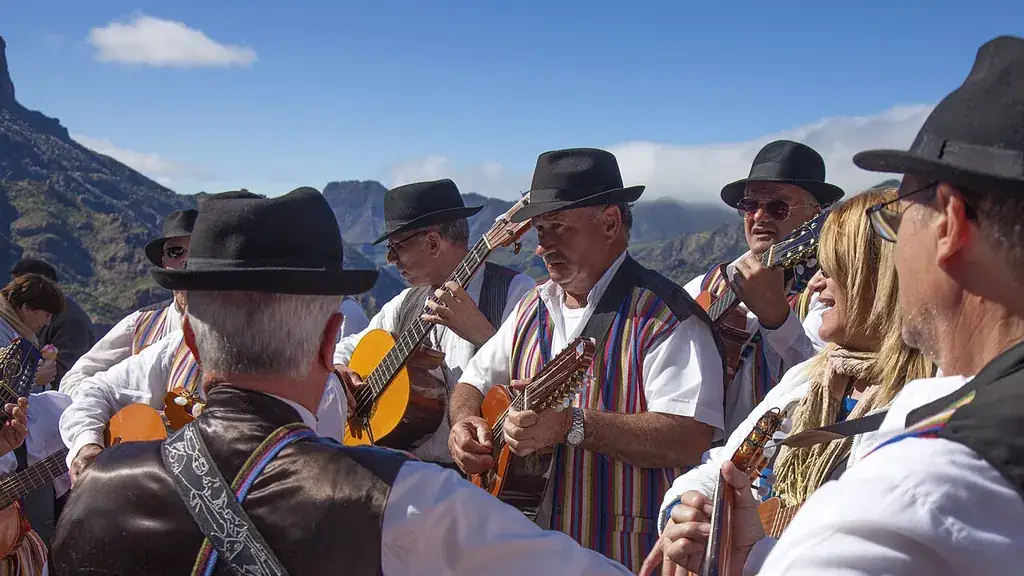
- Parranda
- Group of friends who play and sing popular music, more informal than a folk group. Also the musical get-together itself.
- Pregón
- Speech that officially opens a fiesta, given by a well-known or well-loved person from the village.
- Reina de las fiestas
- Young woman chosen at a gala to represent a village’s fiestas or the carnival. At carnival there are also children’s, seniors’ and drag queens.
- Romería
- Festive procession in honour of a saint with carts, livestock, folk groups and locals dressed as magos. More in what is a Canarian romería.
- Tablas
- Wooden boards on which locals slide down the streets on Saint Andrew’s Day, especially in Icod de los Vinos (Tenerife).
- Baile de taifas
- In some villages of Gran Canaria, a traditional dance during the patron saint fiestas, such as the fiestas of Santa Lucía.
- Timple
- Small guitar, usually with five strings, the most characteristic instrument of Canarian music.
- Traída
- Event in which locals bring something to the village for the fiesta: a boat, a tree, water or firewood, depending on the local tradition.
- Ventorrillo
- Food and drink stall set up during fiestas: grilled pork, skewers, potatoes with mojo, fried fish strips, wine and soft drinks.
- Verbena
- Open-air popular dance, with a live band or orchestra, which usually goes on until the early hours. The night plan at any village fiesta.
- Vino nuevo
- The first wine of the year’s harvest, tasted in November around Saint Andrew’s and Saint Martin’s Day, with chestnuts.
What next?
With these words you can read any fiesta programme. To see what’s on these days, check the agenda.
More guides
- La Orotava’s Corpus Christi carpets: history and how to see them
- The Bajada de la Rama in Agaete: what it is and how to enjoy it
- The Bajadas de la Virgen in the Canary Islands: what they are and when the next one is
- Native sports of the Canary Islands: what they are and where to see them
- Canary Islands Day: why it is on 30 May and how to enjoy it
- The Fiestas del Pino in Teror: Gran Canaria’s great fiesta
- History of the Santa Cruz de Tenerife Carnival
- Saint John’s Night in the Canary Islands: bonfires, swims and traditions
- The pilgrimage to Candelaria: Tenerife’s longest night
- What a Canarian romería is and how to enjoy it
- What people eat at fiestas in the Canary Islands
- Christmas nativity scenes 2026 in the Canary Islands: where to see them, dates and times
- Canary Islands Carnival 2027: dates and themes on each island
- Music festivals in the Canary Islands 2027: calendar with dates, island by island
- Christmas lights switch-on 2026 in the Canary Islands: dates by town
- Christmas 2026 in the Canary Islands: markets, nativity scenes and things to do
- Christmas with kids in the Canary Islands 2026: the best plans, island by island
- New Year’s Eve 2026 in the Canary Islands: where to celebrate
- December long weekend 2026 in the Canary Islands: what to do from 4 to 8 December
- Christmas 2026 in Fuerteventura: what to do from December to Three Kings
- Christmas 2026 in Gran Canaria: what to do from November to Three Kings
- Christmas 2026 in Lanzarote: what to do from November to Three Kings
- Christmas 2026 in Tenerife: what to do from November to Three Kings
- Three Kings parades 2027 in the Canary Islands
- Christmas markets in the Canary Islands 2026: dates, opening hours and places by island
- San Andrés 2026 in the Canary Islands: boards, cans and new wine
- El Hierro fiestas: calendar and traditions
- Fuerteventura fiestas: 2026-2027 calendar
- Fiestas in La Gomera by town: 2026–2027 calendar
- Fiestas in La Palma by town: 2026–2027 calendar
- Fiestas in Lanzarote by town: 2026–2027 calendar
- Fiestas in Tenerife by town: 2026–2027 calendar
- Canary Islands markets: days, times and the best on each island
- Fiestas in Gran Canaria by town: 2026–2027 calendar