La Orotava’s Corpus Christi carpets: history and how to see them
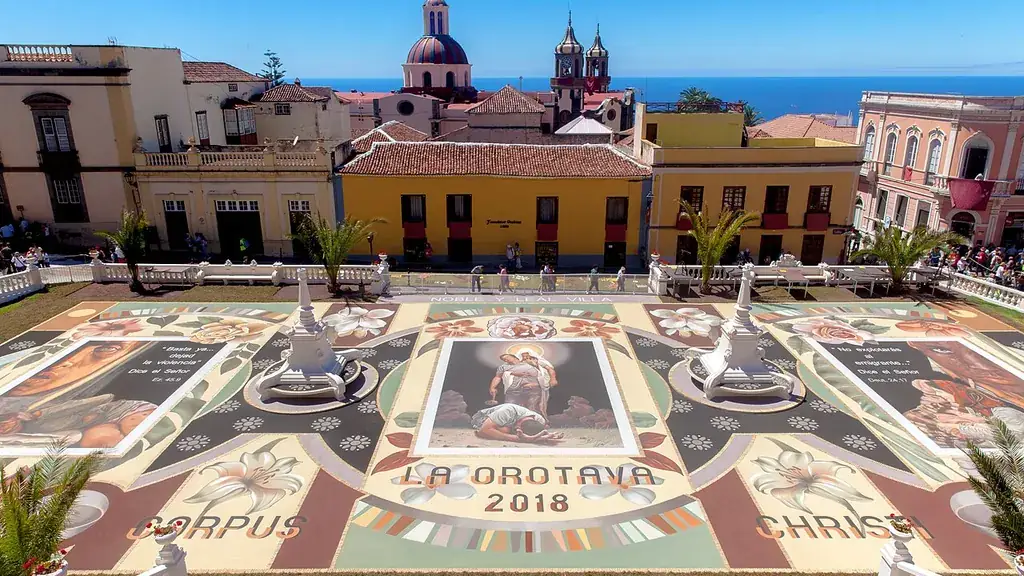
Once a year, the cobbled streets of the historic centre of La Orotava, in the north of Tenerife, wake up covered in designs made of flower petals, heather and seeds, and the Town Hall square becomes a huge picture painted with volcanic earth from Mount Teide. These are the Corpus Christi carpets, one of the most beautiful traditions in the Canary Islands, made by hand by locals for the procession to walk over.
In short: the carpets are made for the Infraoctava del Corpus, the Thursday after Corpus Christi, between late May and late June depending on the year. They can be seen for free from early morning; in the afternoon the procession passes and the carpets are undone. The fiesta has been a Bien de Interés Cultural (protected heritage) since 2007 and is declared of National Tourist Interest. Check the date on the La Orotava Corpus page.
How the carpets began
The tradition is more than a century and a half old. According to the Town Council’s own guide, it began on the initiative of two women of the town, Leonor del Castillo y Bethencourt and María Teresa Monteverde y Bethencourt, who covered the route of the Corpus procession in front of their houses with flowers. Other families followed their example and, over time, the carpets spread through the streets of the old town until they became the great symbol of La Orotava’s fiestas.
On 15 May 2007 La Orotava’s Corpus carpets were declared a Bien de Interés Cultural, the highest level of heritage protection in the Canary Islands.
The flower carpets
The street carpets are made with flower petals, heather, seeds, leaves and other natural materials. The carpet makers, organised in groups of neighbours, design the patterns for months and collect and sort the materials in the days before. The night before and in the early hours of the big day they work against the clock, kneeling on the cobblestones, so that everything is finished by morning.
The designs are usually religious, although there are also geometric and floral patterns. The most impressive thing is the detail: colour gradients achieved only with petals of different flowers.
The Town Hall square tapestry
The masterpiece of the fiesta is the tapestry in the Town Hall square, made not with flowers but with volcanic sands and earth of different colours taken from Las Cañadas del Teide. It covers the whole square and each year reproduces a different work, usually on a religious theme, with a level of detail that looks like painting. Some years sands from the La Palma volcano have also been used.
To see it properly, look for a slightly raised spot around the square: at ground level it is hard to appreciate the whole design.
What happens on the big day
- In the morning, with the carpets just finished, the streets fill with visitors. It is the best time to see them.
- In the afternoon the Corpus procession sets off through the old town, walking over the carpets, which are undone as it passes. That is part of the meaning of the fiesta: they are an ephemeral offering.
- The following Sunday comes the Romería de San Isidro, one of the biggest in Tenerife, which closes the fiestas.
Tips
- Go early. By mid-morning the old town is packed and you move slowly.
- Don’t step on the carpets or lean on the protective ropes: months of work can be ruined by one step.
- Avoid the car. La Orotava’s old town is very steep and closed to traffic; park outside or come by bus.
- Comfortable shoes. The streets are cobbled and very steep.
- Photos yes, but don’t block the way. For a good photo of the tapestry, find a raised spot.
Dates of the carpets
- 🌺 Corpus Christi - Alfombras de La OrotavaTenerife · 3 Jun 2027
- 🪗 Romería de San Isidro - La OrotavaTenerife · 6 Jun 2027
More guides
- The Bajada de la Rama in Agaete: what it is and how to enjoy it
- The Bajadas de la Virgen in the Canary Islands: what they are and when the next one is
- Native sports of the Canary Islands: what they are and where to see them
- Canary Islands Day: why it is on 30 May and how to enjoy it
- The Fiestas del Pino in Teror: Gran Canaria’s great fiesta
- Canarian fiesta glossary: the words you will hear
- History of the Santa Cruz de Tenerife Carnival
- Saint John’s Night in the Canary Islands: bonfires, swims and traditions
- The pilgrimage to Candelaria: Tenerife’s longest night
- What a Canarian romería is and how to enjoy it
- What people eat at fiestas in the Canary Islands
- Christmas nativity scenes 2026 in the Canary Islands: where to see them, dates and times
- Canary Islands Carnival 2027: dates and themes on each island
- Music festivals in the Canary Islands 2027: calendar with dates, island by island
- Christmas lights switch-on 2026 in the Canary Islands: dates by town
- Christmas 2026 in the Canary Islands: markets, nativity scenes and things to do
- Christmas with kids in the Canary Islands 2026: the best plans, island by island
- New Year’s Eve 2026 in the Canary Islands: where to celebrate
- December long weekend 2026 in the Canary Islands: what to do from 4 to 8 December
- Christmas 2026 in Fuerteventura: what to do from December to Three Kings
- Christmas 2026 in Gran Canaria: what to do from November to Three Kings
- Christmas 2026 in Lanzarote: what to do from November to Three Kings
- Christmas 2026 in Tenerife: what to do from November to Three Kings
- Three Kings parades 2027 in the Canary Islands
- Christmas markets in the Canary Islands 2026: dates, opening hours and places by island
- San Andrés 2026 in the Canary Islands: boards, cans and new wine
- El Hierro fiestas: calendar and traditions
- Fuerteventura fiestas: 2026-2027 calendar
- Fiestas in La Gomera by town: 2026–2027 calendar
- Fiestas in La Palma by town: 2026–2027 calendar
- Fiestas in Lanzarote by town: 2026–2027 calendar
- Fiestas in Tenerife by town: 2026–2027 calendar
- Canary Islands markets: days, times and the best on each island
- Fiestas in Gran Canaria by town: 2026–2027 calendar