The Fiestas del Pino in Teror: Gran Canaria’s great fiesta
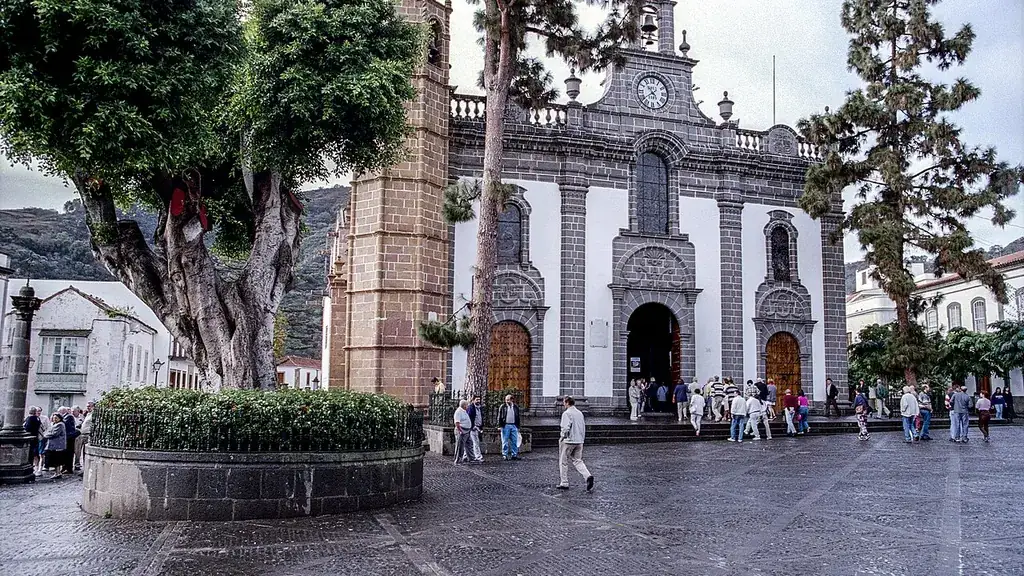
In early September, every road on Gran Canaria leads to Teror. Thousands of people walk through the night to the town, the island’s municipalities parade with their carts in a huge romería, and 8 September, the day of the Virgen del Pino, is a holiday across the island. These are the Fiestas del Pino, Gran Canaria’s main fiesta.
In short: on 7 September the Romería-Ofrenda takes place, in which every municipality of Gran Canaria brings its produce to the Virgin, and that night thousands of pilgrims walk to Teror. 8 September is the day of the Virgen del Pino, with Mass and a procession, and a holiday on Gran Canaria. The fiestas are declared of National Tourist Interest. See the Fiesta del Pino page.
The Virgen del Pino
According to tradition, the Virgin appeared in 1481 on a pine tree (pino) at the place where Teror stands today, inland in the north of Gran Canaria. The town grew around that devotion, and the present-day Basilica of Nuestra Señora del Pino was built at the heart of a historic centre of wooden balconies that is one of the prettiest on the island.
The Virgen del Pino is the patron of the Diocese of the Canary Islands, which covers Gran Canaria, Lanzarote and Fuerteventura, and the great Marian devotion of Gran Canaria. Her day, 8 September, is a holiday on the whole island.
The pilgrimage: the night of 7 to 8 September
On the eve of the main day, the night of 7 September, thousands of people set out on foot towards Teror from different parts of the island, many from Las Palmas de Gran Canaria. This is the Caminata del Pino: some go to fulfil a promise, some by family tradition and some for the experience of walking at night with thousands of people. On arrival, pilgrims visit the Virgin in the basilica, where there is a vigil.
The Romería-Ofrenda
On the afternoon of 7 September the Romería-Ofrenda takes place, one of the biggest romerías in the Canary Islands. It has been held since 1952: 2025 was the 73rd edition. Each municipality of Gran Canaria, along with representatives from the other islands, parades through the streets of Teror with its carts, folk groups and locals in traditional dress, and presents the Virgin with an offering of produce from its land. In 2025 about 40,000 people followed it.
If it is your first romería, it will help to read what a Canarian romería is first.
8 September
On the day of the Virgen del Pino there are Masses through the morning and then the procession of the Virgin through the streets of Teror, with authorities from all over the island and thousands of faithful. According to the usual estimates, between 200,000 and 250,000 people pass through Teror around those days.
The fiestas are not just those two days: for weeks there is a cultural programme, the Gran Canaria Folk Festival, the traditional Mercadillo del Pino market in the streets of the old town and, after the main day, the Romería del Timple.
Tips
- Take the bus. Teror is a hill town with limited access; on those days there are road closures and parking is almost impossible.
- If you walk at night, bring a reflective vest, a torch, water and broken-in shoes, and don’t go alone.
- For the romería, find a spot on the route early: the streets of the old town are narrow.
- Try Teror’s sweets and chorizo, sold at the market and in the town’s shops.
- Bring something warm if you stay at night: in September it gets cool in the hills.
Fiestas del Pino dates
- 🪕 Festival Folclórico de Gran Canaria — Fiestas del PinoGran Canaria · 5 Sept 2027
- 🙏 Fiesta de Nuestra Señora del Pino - TerorGran Canaria · 8 Sept 2027
- 🪕 Romería del Timple — TerorGran Canaria · 11 Sept 2027
More guides
- La Orotava’s Corpus Christi carpets: history and how to see them
- The Bajada de la Rama in Agaete: what it is and how to enjoy it
- The Bajadas de la Virgen in the Canary Islands: what they are and when the next one is
- Native sports of the Canary Islands: what they are and where to see them
- Canary Islands Day: why it is on 30 May and how to enjoy it
- Canarian fiesta glossary: the words you will hear
- History of the Santa Cruz de Tenerife Carnival
- Saint John’s Night in the Canary Islands: bonfires, swims and traditions
- The pilgrimage to Candelaria: Tenerife’s longest night
- What a Canarian romería is and how to enjoy it
- What people eat at fiestas in the Canary Islands
- Christmas nativity scenes 2026 in the Canary Islands: where to see them, dates and times
- Canary Islands Carnival 2027: dates and themes on each island
- Music festivals in the Canary Islands 2027: calendar with dates, island by island
- Christmas lights switch-on 2026 in the Canary Islands: dates by town
- Christmas 2026 in the Canary Islands: markets, nativity scenes and things to do
- Christmas with kids in the Canary Islands 2026: the best plans, island by island
- New Year’s Eve 2026 in the Canary Islands: where to celebrate
- December long weekend 2026 in the Canary Islands: what to do from 4 to 8 December
- Christmas 2026 in Fuerteventura: what to do from December to Three Kings
- Christmas 2026 in Gran Canaria: what to do from November to Three Kings
- Christmas 2026 in Lanzarote: what to do from November to Three Kings
- Christmas 2026 in Tenerife: what to do from November to Three Kings
- Three Kings parades 2027 in the Canary Islands
- Christmas markets in the Canary Islands 2026: dates, opening hours and places by island
- San Andrés 2026 in the Canary Islands: boards, cans and new wine
- El Hierro fiestas: calendar and traditions
- Fuerteventura fiestas: 2026-2027 calendar
- Fiestas in La Gomera by town: 2026–2027 calendar
- Fiestas in La Palma by town: 2026–2027 calendar
- Fiestas in Lanzarote by town: 2026–2027 calendar
- Fiestas in Tenerife by town: 2026–2027 calendar
- Canary Islands markets: days, times and the best on each island
- Fiestas in Gran Canaria by town: 2026–2027 calendar